I love it when March, Adar, and Purim coincide. Instead of talking about just Esther and Purim with my classes, I can talk about women of valor, not just one woman of valor.
Here’s a quick challenge: how many Jewish women of achievement can you name in one minute? How many Jewish women Nobel Prize winners can you name?
Our little library has over 100 listings for biographical information about women, and that doesn’t include reference books.
And, by the way, about 20 Jewish women have won the Nobel Prize. There have been 68 female Nobel laureates. (Marie Curie won twice.) So about 30 per cent of the winners have been Jewish women. Not bad.
Jewish women have achieved in all sorts of fields. They have reached for the stars and explored the oceans; they have excelled in sports and in letters. One Jewish woman even helped write the modern Japanese constitution.
Many have been unsung or cheated out of honors because of the chauvinism, politics, and mores of their time.
Take a look at the book display about some of our Women of Valor. How many are new to you?
Even if your age is well into the double digits, don’t overlook the picture books. Reading a well-written and well-researched picture book is an efficient way to learn something new, and the illustrations add interest, information, and details. In addition, many short picture book biographies have notes and more in-depth information in the back which expand the basic text.
Here are some of my favorites. There’s even a Ruth on this list, but not the one you might expect.
Arato, Rona. Nothing Could Stop her: the courageous life of Ruth Gruber (1911-2016). Gruber was a journalist who traveled the world and its hotspots for over 70 years.
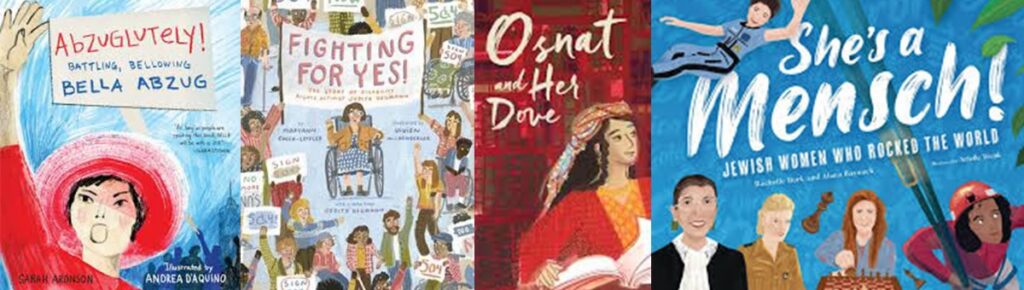
Aronson, Sarah. Abzuglutely: battling, bellowing Bella Abzug (1920-1998). Picture book biography of the outspoken politician and women’s rights activist from New York.
Blumenthal, Deborah. Parrots, Pugs and Pixie Dust: a book about fashion designer Judith Leiber (1921-2018), who found her niche as the designer of fantastic and fascinating pocketbooks that are museum-worthy.
Burk, Rachelle. She’s a Mensch: Jewish women who rocked the world. Brief biographies highlighting the accomplishments of some famous and not-so-famous Jewish women of note.
Catarevas, Eve Nadel. Rena Glickman, Queen of Judo (1935-2009). Also known as Rusty- for her red hair- Kanokogi, Glickman’s activism and tenacity made judo a sport accessible to girls and women. She was also an Olympic coach.
Cocca-Leffler, Maryann. Fighting for Yes!: the story of disability rights activist Judith Heumann. (1947-2023) She fought for inclusion for people with both physical and mental disabilities, and because of her leadership and tenacity, using a wheelchair or pushing a baby stroller is far easier today.
Dubbin, Lori. Perfect Match: Althea Gibson and Angela Buxton. (1934-2020)At first rivals and later partners, Black American champion Althea Gibson and white, Jewish Brit Angela Buxton fought discrimination on the tennis courts.
Goldberg, Bonni. Dona Gracia Saved Worlds. (1510-1569) Forced to leave Portugal, where she had been raised as a converso or “New Christian,” widowed Gracia traveled from one major European city to another, saving Jewish communities with her enormous wealth and strategic plans. A true heroine of a time when it was not safe to be a Jew.
Krasner, Barbara. Goldie Takes a Stand: Golda Meir’s first crusade.(1898-1978) Russian-born and American-raised, Meir’s politicking and outspokenness began in her Milwaukee school.
Lakritz, Deborah. A Place to belong: Debbie Friedman sings her way home.(1951-2011) Brief biography of the woman who changed the face of Jewish music. You may not know it, but some of our most familiar tunes were written by this modern musical pioneer.
Michelson, Richard. Fanny’s Big Idea: How Jewish Book Week was born (1895-1961) Fanny Goldstein’s simple celebration of Jewish books in her Boston Public Library has grown into an annual national celebration of Jewish literature.
Samuel, Sigal. Osnat and her Dove: the true story of the world’s first female rabbi. (1590-1670) Osnat Barzani was raised to be a scholar since she had no brothers. When both her father and her husband died, she took over both their teaching and the prayer leading duties. She was admired for her scholarship and skill.
Stone, Tanya Lee. Remembering Rosalind Franklin: Rosalind Franklin and the discovery of the double helix structure of DNA. (1920-1958) Franklin was truly written out of history. As a lab partner of Watson and Crick, who won a Nobel Prize for their work on DNA, her research and important photographs were barely acknowledged. Her career was cut short by her premature death from cancer. Indeed, she was written off by the researchers as a hysterical, humorless woman. Shame on them!