As If: Choosing to Believe (Yom Kippur 5786)

To watch the sermon, click here.

When 20-year-old Agam Berger was released from captivity in January, she walked onto an Israeli military helicopter, and—like the other released hostages—was handed a small white board so she could write a message to the world. Cameras were waiting, her family was waiting, Israel was waiting. She could have written anything, or nothing at all. But her words reverberated around the Jewish world, as we watched with tears in our eyes.

In shaky handwriting, she wrote words of gratitude to Am Yisrael, the Jewish people, and the IDF heroes who had risked their lives to rescue her. But above that, her first words, she wrote, “I chose the path of faith, and in the path of faith I returned.”

Mind-blowing. She had been kidnapped, lived in terror, held underground for weeks, and subjected to things beyond imagination. What does it mean to choose faith, when there is every reason to despair? What does this mean for us, sitting here today on Yom Kippur?

Because I bet if I took a straw poll right now—of the many reasons why you are here today, faith would not even register in the top five.

******************************

“What are you writing your sermon about?” a friend asked me on the phone the other day. “Faith,” I told her. “Isn’t that for Christians?” she asked. I laughed and thought: Exactly.

My dear friend Rabbi Lori Koffman once told me about her very first days of chaplaincy training at a hospital in New York City. She was still a student then, still trying to figure out what it meant to be a rabbi, when she stepped into an elevator one afternoon and found herself standing with a woman she had never met.

The woman turned to her and asked, “Do you know where the chapel is?” Rabbi Koffman nodded, ready to point the way—but before she could answer, the woman continued: “My sister just gave birth, and the baby is struggling. I just need a place to pray.” Rabbi Koffman hesitated for a moment, then leaned into her new role and said, “If it would help, I’d be glad to come sit with you and your family.”

The woman’s face lit up: “That would be great.”

They got off the elevator together and entered the chapel, where the whole family had gathered. The woman announced to everyone: “You won’t believe what happened! I was on my way to pray, and the chaplain was right there in the elevator. God sent her to us—just when we needed her.”

Later, Rabbi Koffman reflected: I didn’t see it that way. To me, it felt like coincidence. But for her, it was God’s hand, clear as day. And that made her wonder: What if she was right? What if God was there, and I did not know it?

******************************

Or take my friend Jeff, an Episcopalian minister whose wife went in for routine surgery and never made it out. Who just married off a daughter who lost her mother only a few months before the wedding. Who went on vacation by himself because he’s widowed now and has no one to go with.

At the pool one day, he watched a woman helping an old man into the water. And in that moment, he felt—he knew—that God was there with him. That the simple act of kindness he was witnessing was a portal into God’s presence. Despite his grief and loneliness, he felt God was with him, poolside.

******************************

We have so many reasons not to believe. We’re smart, educated, skeptical. We pride ourselves on our intellect. We know science, physics, biology. Who needs God? It makes zero sense, and we went to college and university, and we’re not that dumb.

Also, we know Job’s ancient question: if there is a God, why do good people die young, why Holocaust, why war and tsunamis, catastrophes that insurance won’t cover because they are “acts of God”? I mean, who wants that God in their life? No, thank you. 

Or, we look around and see religious zealotry, the ways religion gets twisted, Jewish or otherwise, into something harsh and fanatical. 

But here’s the thing: all of our skepticism and shifting around in our seats, avoiding the topic, is the answer to the wrong question. I’m not here asking why do you believe or not believe. I’m asking: what would it do for us, for the world, if this Yom Kippur we chose to believe? Like Agam’s handheld sign – we might choose the path of faith.

After all, Judaism does not require belief as a membership card—so it is going to have to be a choice that we make. Yes, there are certain beliefs that disqualify—belief in more than one god, for example, or worshipping gods of another religion. But beyond that, there are so many choices, so many ways to choose faith.

Jewish faith is not about certainty. Faith is about possibility. It is about choosing to live as if.

And yet—we psych ourselves out of it.

I’ll tell you a story I love. Some Jewish friends ended up in conversation at some kind of function with a group of people who weren’t Jewish. These people were full of questions about Judaism, and so the Jews are explaining about peoplehood and history and community and holidays and food. Then came the question: “What about God?”

“Oh, we don’t believe in God,” they said. The people who weren’t Jewish looked puzzled. As they continued asking, the Jews found themselves explaining that Judaism is more than “just” a religion, it’s a culture, it’s a values system, etc, etc, and finally one of them said: “So wait, are you saying that in Judaism, God is a bonus?”

Yes. Exactly. I love that line! God is a bonus. You can be Jewish without faith. But why would you do it without the bonus? It costs you nothing and gains you so much! For me, God is the bonus that makes the whole thing stick together. I know that’s not true for everyone, though. The story is funny because we can feel the truth in it, how there are so many ways to be Jewish and live a rich Jewish life, and even come here on Yom Kippur that have nothing to do with God, but let me say, as your rabbi: we are also a faith. Why are we giving up on that? Why wouldn’t we give ourselves the bonus?

I laughed recently when I looked at the books on my night table. On one side: Super Attractor by Gabrielle Bernstein. On the other: Emunah v’Bitachon—Faith and Trust—by the Chazon Ish, Rabbi Avraham Karelitz z”l. One’s a bestselling self-help guru from Westchester who has her face on the cover; the other, an early 20th-century Orthodox rabbi from Belarus who made aliya in 1933, settled in Bnai Brak and became one of the leaders of the Haredi ultra-orthodox community who is known by the name of his series of writings on Jewish law, who also sold millions of books. They could not be more different.

And yet—they’re saying the same thing. Gabby (as she calls herself) invites millions of people to “trust the Universe.” – capital U on Universe. You can go on her website and join the 21-day Trust the Universe Challenge, or you can buy her journal, where you list what you want to manifest in your life. The Chazon Ish wants you to take on pray every day and adhere to Jewish rituals as a means of cultivating emunah (faith) and bitachon (trust). She has a 3-step process she calls Choose Again – where, get this, you first notice the negative thoughts patterns or feelings, then you forgive yourself for it, and then you choose to do it differently. I’m sorry, but isn’t that exactly what we are doing here? Isn’t that teshuvah? His recipe would be what Maimonides teaches: you do teshuva, but asking forgiveness for the thing you did, and then when you’re in the same situation next time you don’t do it. It’s the exact same thing. Both tell us that if we do these things, then we will achieve a sense of serenity and calm. She talks about manifesting abundance; he talks about seeing God’s goodness everywhere so you feel the abundance of God’s blessings. Different words, different audiences, but over and over again the same messages.

Here’s the question: why can we stomach “trust the Universe” when it’s in English, but psych ourselves out of it when it’s in Hebrew? (And it’s not just that Hebrew is hard for us, I don’t buy that it’s just a linguistics issue.) Why do we embrace a secularized faith, the “Believe: sign over Ted Lasso’s locker room, or insist with the Mets “You Gotta Believe”, but deny ourselves Jewish faith? Why do we let ourselves be spiritual everywhere except here?

******************************

Our Torah gives us some helpful models.

Jacob. On the run from his brother Esau, Jacob lay down in the wilderness with nothing but a stone for a pillow. In his sleep, he dreamed of a ladder reaching to heaven, with angels ascending and descending upon it. God appeared to him with words of blessing and promise. When Jacob awoke, shaken, he declared: “Surely God was in this place, and I did not know it.” His story teaches that faith can come not in grand temples, but in lonely, ordinary places where we least expect it.

Aaron. After the unimaginable loss of his two sons, Nadav and Avihu, Aaron might well have turned away from God altogether. Instead, the Torah tells us that on Yom Kippur, Aaron dressed once more in his priestly garments and stepped into the Holy of Holies to perform the sacred service on behalf of the people. We do not know what was in his heart—perhaps silence, perhaps doubt, perhaps anger—but outwardly he continued to serve. His story shows us that sometimes faith is not certainty or joy, but simply the courage to stand and act k’ilu—as if we still believe.

Hannah. Despairing at not having children of her own but turning to God and praying for help, with bitachon— trust—that an answer would come in some way.

Job. When Job loses everything—his wealth, his health, his children—he sits in ashes, broken and despairing. His friends insist he must have sinned, but Job refuses to accept easy answers. Instead he cries out, raging at God, demanding justice, demanding to be heard. What is striking is not his patience, but his refusal to let the relationship die. Job’s story teaches that faith is not quiet resignation, but the audacity to keep speaking to God, even in anger and anguish.

Faith, in Torah, is not about never doubting. It is about daring to keep praying, keep acting, keep living as if. K’ilu, in Hebrew, “as if.” K’ilu is used in modern Hebrew the way we use “like” in English – like, it doesn’t really mean anything, but like, k’ilu, it does. Can we live as if God existed, k’ilu God hears our prayers. Because we don’t know—but we might choose to believe anyway.

So let’s try this together. A small experiment, because try as he might, Maimonides’ 13 Articles of Faith never took off, we never really wanted to agree to believe just one thing about God. We have so many choices in our choosing to believe. So here we go. Everyone:

a) Point one finger straight up. That’s the God who is above and beyond. Theologians call it supernaturalism, God up there outside of nature and us.

b) Now spread your arms wide. That’s the God who is everything. Pantheism, God might be everything, wherever you look, whatever you touch, it’s all God.

c) Next, cross your arms in an “X.” That’s no God at all. 

d) Now: place one hand on your heart, and lift your other hand upward. Panentheism, this one is called. God is in everything, but also beyond everything. God is both with us and bigger than us.

e) And one last one: Swirl your hands – this is process theology – God in process, always changing and now hold hands with the person next to you – process theology holds that God and the world are in relationship, we influence each other, and as we change and grow, so God changes and grows. [release hands]

This is the wide range Judaism allows. No catechism, no one right answer. Just the courage to live as if.

Our ancestor Jacob said, “God was here, and I did not know it.” That could be our line too.

Agam’s whiteboard. The elevator ride. Jeff at the pool. Aaron in his grief. Job in his cries.

Yom Kippur asks us: Will we dare to live as if God is here?

Not because we solved the problem of evil. 

Not because we figured out dinosaurs on the ark. 

But because faith might just light us up inside, comfort us in sorrow, and strengthen us for tikkun olam.

So today, I don’t ask for belief. I ask you to consider the possibility of faith. To live, this year, as if.

Because maybe—just maybe—God was in this place all along. And we did not know it.

Your Story and Your Service: A Sermon for American Jewry (Rosh Hashanah 5786)

To watch the sermon, click here.


A few months ago I received something wonderful and awful in the mail. It was a postcard, it was green, and it informed me that I was being summoned for jury duty. Not just any jury duty, mind you, but grand jury, one full day a week for 17 weeks, every Thursday from August through Thanksgiving.

My first thought: A rabbi, serving jury duty in September? No way. Everyone I told agreed. I was sure I’d get out of it.

The appointed day arrived. I walked into the court building in Newark full of excuses. I had a letter describing my duties here. I wore my kippah – I don’t always wear my kippah in public spaces but I had it on that day, part of my strategy to get out of this – and a well-practiced script in my mind.

About one hundred of us sat in the appointed room. The clerk explained: one by one you will be called before the presiding judge. The judge will ask you one question: Can you serve? It is a yes or no question. There are two answers: yes, or no. That is all. Not your excuses, or your reasons or your backstory. Can you serve?

And then she said something that completely shifted the scene for me: “I know a lot of you came here today thinking you were going to get out of this. But this might transform your life. You might hear things that change you. You’ll get to know new people, and you’ll learn a whole lot about the community you live in. This country needs its citizens for the justice system to work. Can you serve? Yes or no.”


What a question for 2025. In Israel, the question of compulsory military service is heartwrenching, from the national conversation over the ultra-orthodox refusing to serve, to the families sending their sons, daughters, and husbands into a war zone. Here in America, we’ve become cynical, skeptical that our service – be it jury duty, voting, or participating in public life – even matters. “Can you serve” sounds less like an ethical summons than a request for a second helping of dessert.

Our ancestors asked this question, too. They knew the question runs deep. They gave us a phrase that is inscribed in so many sanctuaries around the world, including our own, right here above the ark behind me: da lifnei mi atah omed. Know before whom you stand. Our sense of service begins with that awareness. 

Before whom do you stand today?


Last year on the shabbat of July 4th weekend, I shared a story that I love. It is the story of a man you’ve probably never heard of, named Jonas Philips, a Jew who came to America from Germany in 1756. He arrived in Charleston, an indentured servant to another Jew.  By 1776 he had earned his freedom, and was living in New York with his wife and – get this – their 21 children. A patriot, Jonas Phillips joined the fight for American liberty and fought in the Revolutionary War. He loved the idea of this country. But he had a problem.

In Pennsylvania, where he moved after the British invaded New York and where he stayed after the war, you could not serve in the legislature unless you affirmed under oath that both the Old Testament and the New Testament were divinely inspired. Aware that no Jew could take such an oath, Philips wrote a letter to the Constitutional Convention. He reminded the delegates that Jews had “supported the cause, bravely fought and bled for Liberty” – but could not swear against their faith.

And at the top of the letter to the framers of the Constitution, he wrote the date: September 7, 1787, or 24th Ellul 5547.

24th Ellul 5547 – he put the Jewish date at the top of the letter! Recall there were no Jews participating in the Constitutional Convention, and George Washington and his peers must have been mystified by that opening line. Rabbi Meir Soloviechik calls these 8 words – “September 7, 1787 or 24th Ellul, 5547” –  “the most audacious words in American Jewish history.” Audacious because Philips insisted he would not amputate his faith to serve his country. Audacious because he dared to hold both commitments together, his faith in America and his faith as a Jew. He stood before the founders of this nation, as a Jew, and he stood before God as an American. He knew before whom he stood.


So here we are, 238 years later, in a bewildering America. I wanted to share the story of Jonas Philips because I’m not sure we know what stories we are still telling about ourselves…or how those stories connect to our sense of service.

As Americans, we’ve become so focused on flaws—of our founders, our leaders, our neighbors—that we risk losing faith in the nation itself.

What story are we telling about America? Are we making it great, or greatly misguided? When someone is shot – on the street, at work, or on a stage – how is the story anything but one about murder, failed mental health care, easy access to guns and moral collapse? How can anyone justify the death of the innocent? When a news anchor is fired over remarks about the government – is the story about censorship, or accountability? What stories are we telling?

And as Jews, it is even worse. All year we’ve been hearing stories other people have been telling about us: that we (God forbid) are bloodthirsty, merciless, inhumane. That (has v’shalom) we care only about money or power, that we are among the cruelest peoples on earth committing the worst atrocities. This war is complicated and cruel, but we know for sure none of those stories is our story. None of those stories are true.

When a 12-year-old sat in my office recently and said about her Instagram or Tiktok feed: I just don’t know what stories are true or not – I thought: welcome to the club.

So here is my question for us, this Rosh Hashanah on the the eve of this county’s sesquicentennial: what stories are we telling about ourselves, and how do they enable us to serve?

Here is a story that can help us. The story of Joseph. Which is action packed, full of ups and downs. Some pretty terrible things happen to him, including his brothers planning to kill him, being sold off into servitude in another country, and Potiphar’s wife falsely accusing him which lands him in jail for many years. But he never loses his faith in God and eventually he becomes Pharaoh’s right hand man.  You probably know the rest of the story: he creates a plan to store Egypt’s crops for the famine that he predicted in Pharoah’s dreams, and his brothers, who have run out of food, come to Egypt to beg for help, not realizing he is their brother.  When he finally reveals his identity the brothers are astonished and terrified. They’re sure he will want vengeance. But that is not the path Joseph chooses. Instead he says:

 “You meant it for harm, but God meant it for good.”

That line is everything. Because Joseph takes hold of the pen. He takes control of the narrative. Instead of revenge, he writes reconciliation. Instead of betrayal, he writes redemption. Instead of brothers fighting he writes a story of brothers helping one another and becoming close. Instead of letting others tell his story, Joseph tells it himself.

We choose how to tell the story. WE choose what story to tell. And that choice shapes not only us and our relationships, but the world.

This is what Professor Jennifer Mercieca at Texas A&M found, in a recent experiment with her students that I’m a little obsessed with.

Like many of us, Dr. Mercieca’s students were chronic doomscrollers, their phones “misery machines.” Instead of accepting it, she tried something new: what if they spent time hopescrolling? She had them create accounts devoted to solutions journalism—stories of problems solved and hopeful headlines. None went viral, but what happened to the students was remarkable.

Fixing the News, Sept 18, 2025:

“Many of [her] students reported that the experience was both illuminating and healing. “Before our Hopescroll project,” one wrote, “I really didn’t realize the amount of negative content I consume daily. I see scary news articles, I see people being mean to one another on social media, and I spend hours scrolling through posts that have no meaningful purpose.” Some students even noticed that their social media algorithms began to change, as they started to see more positive content on their feeds instead of so much doom.

What Dr. Mercieca’s experiment shows is that we’re not passive victims of algorithmic manipulation. We have more power than we think. Every time we share outrage bait or doom-laden headlines, we’re feeding a machine that makes everyone more miserable. But we also have the ability to choose differently. The algorithms will follow us wherever we lead them. We just have to decide what story to tell. This is not just true online. It is true in real life.

When that court clerk told me the story of jury duty, I changed. When Jonas Philips wrote the Hebrew date atop a letter, he changed the unfolding of history.

We stand (and sit and stand and sit) in synagogue on a weekday in September. The beginning of a new year, 5786. Both dates written in bold at the top of this page of our lives. We stand before our history, before one another, and – as our ancestors imaged on this Day of Judgment – before God who has each one of us stand one by one and asks us: Can you serve?

We know the answer is yes. But how do we go about it? First, by turning to these words over this ark as a reminder.

Know before whom you stand.

Today we stand before something larger than ourselves.

Know before whom you stand:

-God.
-History.
-Future.
-One another.

We stand before our grandparents who sat in these pews, and the ones who perished so that we could.

We stand before our grandchildren who will inherit this earth, and the wars we do not turn into peace, and the messes we do not clean up.

We standing before one another. We stand before history. We stand before the future. We stand before all we hold dear. Da lifnei mi atah omed. Know before whom you stand.

And then, decide: what stories will you tell this year, and how will they enable you to serve?


The blessing we offer one another at this time of year is Ketivah Tovah. May you be inscribed in the book of life.

But I think this year we need to think of it this way: May we inscribe the Book of Life. May we fill our next pages with stories of sweetness, of progress, of hope, of all the ways we serve.

May we stand before one another this year and write one another into our story in love and in peace, and most of all, in service. And then may God seal it for good, gmar chatima tovah.

Let us say: amen.

Grandparents


You might expect this week’s blog to be about Rosh Hashanah and Yom Kippur or even about Hispanic and Latino Jews since September is Hispanic Heritage Month, but it’s about grandparents.

Why? As we approach the High Holy Days, many of us spend time with families and think about our relationships with our grandparents. Those of us who are older may even say kaddish for them during the Yom Kippur Yizkor service. Children hopefully look forward to spending time with their grandparents and forming memories. No matter what, none of us would be here without those grandparents.

And by the way, the Hallmark Holiday Grandparents Day is celebrated on the first Sunday in September.

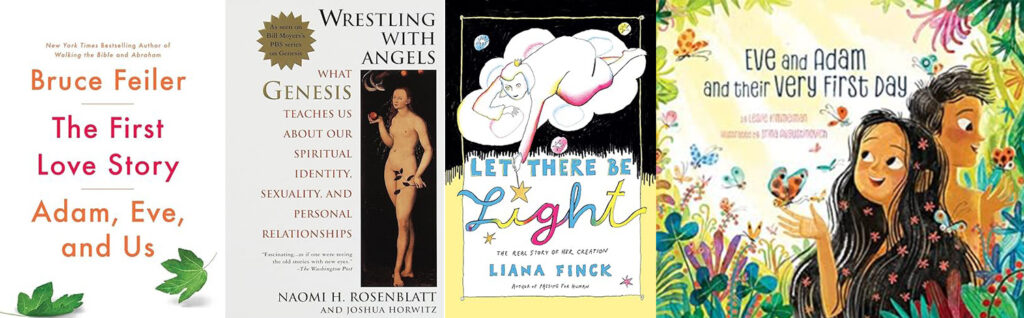
Here’s a selection of books for kids and adults celebrating grandparents:

Berest, Anne. The Postcard, which suddenly turns up, is at the center of this fictionalized history-mystery about the author’s great-grandparents who were killed in the Holocaust. (FIC)

Kalb, Bess. Nobody Will Tell You This but Me is a memoir of Kalb’s relationship with her now deceased grandmother, from whom she learned about life and love. (BIO)

Shalev, Meir. My Russian Grandmother and her American Vacuum Cleaner is the author’s story of his Russian Jewish family told humorously and lovingly through his super-cleaner grandmother. (BIO)

Tuininga, Josh. We Are Not Strangers is a historical fiction graphic novel set in Seattle during World War II. Marco’s father was a first-generation immigrant who befriended and supported the Japanese-American community after Executive Order 9066, which sent Japanese-Americans to internment camps, went into effect. (FIC)

Davis, Aubrey. Bagels from Benny is a retelling of the tale of bread left in the ark for God to eat. Young Benny helps his grandfather in his bakery and learns some important life lessons. (E)

Heller, Linda. The Castle on Hester Street, where Julie’s grandparents lived — was it a castle or a dump? It all depends on your point of view. (E)

Oberman, Sheldon. The Always Prayer Shawl has been handed down from one generation to the next. Beautifully illustrated. (E)

Rosenberg, Madelyn. This is Just a Test takes place in 1983 during the Cold War. David Da-Wei Horowitz is worrying about so many things: his upcoming bar mitzvah, his grandmothers (one Chinese and one Jewish) who argue all the time, a trivia contest, and his best friends who don’t like each other. (JFIC)

Saltzberg, Barney. Tea with Zayde (Grandpa) is a delightful story of teatime with Grandpa. Perfect for little readers, it has a surprise ending. (E)

Schwartz, Howard. Gathering Sparks introduces the concept of tikkun olam. (J398.2)

Desire Lines

My walk to Oheb takes me across Grove Park. Dotted with giant, 200-year-old trees when we moved to town a few years ago, the ash blight has turned the park into a sunny field distinguished by just a solo playground. The paved walkway encircling the park serves as a track for the morning runners and stroller-walker set, and keeps us off the beautifully maintained green grass that no longer encircles age-old trees.

My walk doesn’t really start where the paved pathway does, and so I cut across the grass. I’m not the only one. There is a dirt groove, a ribbon of brown icing across the green frosted cake of lawn. Many of us, it seems, needed – wanted – a path where there wasn’t one, and so ended up (without organizing, without trying to) creating one of our own.

This is known, in urban planning parlance, as a “desire line.” I love that. I love that there was a plan, and it was a very good one, and still serves so well: the park, the grass, the playground. But over time, desire shifts. Needs change. “We paved the paths already!” you can hear the frustrated urban planners sighing. “We planted the trees and set it all up!” Yes. And also, there’s this desire line, over here. Come look at what else.

We have wrinkle lines, frown lines, tanning lines, to say nothing of the scars, tattoos, and other evidence of desire—or its opposite—written in these bodies of life lived. Desire lines are the paths worn into the ground by repetition. Unplanned but chosen, over and over again.

I love that the launch of the school year coincides in the northern hemisphere with Rosh Hashanah and our High Holy Day season. Right now, it is Elul, the last month of the year 5785. Our kids have a new start with new teachers, and we too crave a new beginning and give it to ourselves thanks to the Jewish calendar. A new year, we declare. The shofar calling us, beckoning us to see the desire lines we’ve unwittingly sown into the soil of the four seasons behind us. Looking back is the only way to see the path we are on.

“Please teach me Your way,
And lead me on a level path…”
(Psalm 27:11)

How do we stay on level ground? How do we make sure it’s not all uphill—or even worse, all downhill? Psalm 27, the psalm of this season, can be on our lips every day from now through Rosh Hashanah and Yom Kippur, straight on through the end of Sukkot. Are we asking for God’s help, or for one another’s? Both?

What kind of friend do you want to be? What kind of partner, what kind of child to your parents—be they dead or alive? What kind of parent to your children—be they dead or alive? Whom do you desire to become in 5786, and what paths must you tread to become that person?

In the coming weeks, we will, I hope, have much time together. It feels like a new beginning we make together. With all that we desire. My path brings me straight across Grove Park to each of you. I hope to sing with you, and pray, and laugh. I hope to share tears of joy and sorrow, and stories of love, hope, and faith.

May the desire lines we tread together lead us to the places we dream of going. May they guide us into hope when hope seems far, into strength when the way feels steep, into joy when the grass grows over old roads and we find ourselves ready to walk anew.

This year, may we walk not alone, but together. May our steps make new grooves in the earth, worn not by habit but by heart. And may those paths, unplanned but chosen again and again, carry us—toward one another, toward the Source of Life, toward the future we dare to desire.

It’s Back-to-School Time


Summer is unofficially over as of Labor Day, although there are still about 3 weeks until the seasons officially
change.

Kids want summer to go on forever; their parents are happy to see school on the horizon, and older folks
are amazed at how fast the summer has flown by.

We welcome fall in the library with a selection of books about back to school, learning, and finding one’s place in
the world, making new friends, and how to face challenges.

For many additional titles, check the online catalog.

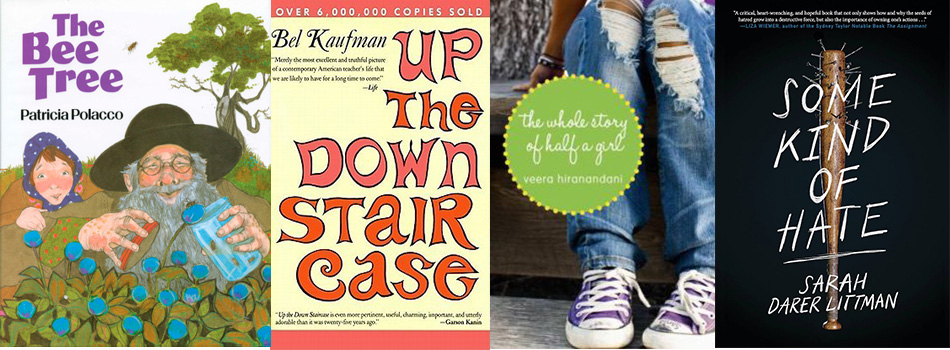
Blumberg, Ilana. Open Your Hand seeks to answer the question of how teachers deal with the issues of the
21st century. (NONFICTION)

Hiranandani, Veera. The Whole Story of Half a Girl. Sonia, half-Jewish and half-Indian, must find a way to
adjust to a new school when her father loses his job and she goes to a public middle school. (JFIC)

Jules, Jacqueline. Drop by Drop: The Story of Rabbi Akiva. Encouraged by his wife, 40-year-old Akiva
learns to read. (PICTURE BOOK)

Kaufman, Bel. Up the Down Staircase. First published in 1964, this fictionalized look at a year in a New
York City high school is a funny, poignant, modern classic written by a granddaughter of the famed Yiddish
writer Sholem Aleichem. (FICTION)

Littman, Sarah. Some Kind of Hate. Freshman Declan injures his pitching arm. In his anger, he becomes
involved with white supremacists and turns against his Jewish friend. When violence occurs, Declan has to
decide what side he’s on. (YAFIC)
|
Oren, Dan. Joining the Club: A History of Jews and Yale. Covering the years 1809, when the first Jew
graduated from Yale, to 1988, this book was the first analysis of anti-semitism in an American university. It is
both a history of Yale and a study of the social mores of the time period. An interesting read in light of what
is happening at universities now. (NONFICTION)

Polacco, Patricia. The Bee Tree. An expanded tale of the old custom of spreading honey on the letters of
the Aleph-Bet as a child first learns to read, this beautifully illustrated story shows the close relationship of a
grandfather and his young granddaughter. (PICTURE BOOK)

Schroeder, Peter. Six Million Paper Clips: The Making of a Children’s Holocaust Memorial. In order to
help understand the Holocaust, middle school students in a small all white, Protestant town in Tennessee
collected 6,000,000 paper clips. The ultimate result was the Children’s Holocaust Memorial. (JNF)

Weatherford, Carole Boston. Dear Mr. Rosenwald. Seen through the eyes of Ovella, the reader learns the
story of Julius Rosenwald, the president of Sears, Roebuck and Company, who funded scores of schools in
the South and the impact these schools had on the communities they served. (PICTURE BOOK)

Wiemer, Liza M. The Assignment. When they protest an ill-conceived class assignment to debate Hitler’s
Final Solution, Seniors Cade and Logan involve the entire community in the controversy. Based on a real incident from 2017. (YAFIC)

Summer in the Book


As the summer begins to wind down (even though it’s not officially over until September 22), let’s try to capture some of its last glory and intensity through books set in the summer. The following fiction and nonfiction books are available in Oheb’s library.

Yael Van de Wouden’s The Safekeep takes place during the hot summer of 1961 in the Netherlands. It’s long enough after World War II, that all should be calm. But Isabel, living in her mother’s house in rural Netherlands, discovers that some wars are never really over and things are not always as they seem. This novel was short-listed for the Booker Prize and winner or nominee for many other literary awards.

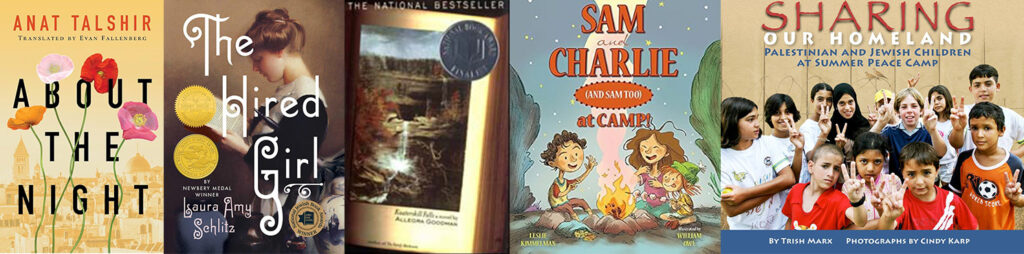
Anat Talshir’s About the Night is set in the summer of 1947, a perfect time to fall in love. But Elias and Lila come from two different worlds: Elias is a Christian Arab; Lila is a Jewish Israeli. He lives on the eastern side of a divided Jerusalem, while she lives in the western part. This is a never-ending love story plot.

Allegra Goodman‘s Kaaterskill Falls takes place in 1976 in upstate New York, where scores of religious Jews make the trek from the city to one of the many summer communities. The story focuses on the restless Elizabeth and the confused Andras. The village’s Rebbe also has his struggles, as does the local judge, who is faced with the problem of overdevelopment that will change the village’s character. This book was a National Book Award finalist and winner of the Edward Lewis Wallant Award.

Laura Amy Schlitz’s The Hired Girl has escaped her dull, hard life on a Pennsylvania farm to work as a maid in a wealthy Jewish household in Baltimore. It’s the summer of 1911, and the work can be as difficult as farm work in its own way, especially when Joan finds herself out of her element trying to understand this family whose customs are so foreign to her. This young adult novel is an award-winning coming-of-age book that also has appeal for adults.

Gayle Forman’s Not Nothing features 12 -12-year-old Alex, who has to spend the summer volunteering at a senior residence. His relationship with one of the residents, a Holocaust survivor, may change his life.

Leslie Kimmelman‘s book about friends Sam and Charlie (and Sam too) at Camp is a low-key early chapter book about friendship and the outdoors. It is suitable for readers just beyond easy readers.          

Elizabeth Lenhard’s The Ball of Clay That Rolled Away is a perfect summer picture book. The setting is pottery day at summer camp, when the clay goes rolling out of the pottery shed where it was being molded into Jewish ritual objects. Will it be stopped before it ends up in the lake?

As the October 7 War nears its second anniversary, one wonders if peace and friendship can ever be achieved between Palestinians and Israelis. Some people feel that people-to-people contact is the way to achieve understanding, if not peace. Sharing Our Homeland is Trisha Marx’s photo essay on the Summer Peace Camp, which has brought teens from both sides together for many summers. Amazingly, the camp is still going strong, although under much different circumstances since the October war began. Read about the Youth Peace Camp and the long-running Seeds of Peace, located in Maine.

Summer Nonfiction


Lots of people shy away from nonfiction, thinking that it’s going to be dense, dry, and dreary. But well-written nonfiction, especially narrative nonfiction, can be as exciting as the latest best-selling mystery or romance. Biography easily lends itself to good narration since it’s the story of people’s lives, while history is a close second when it tells the story of true events.

As with previously recommended books, these are available in both the BCCLS system and in our library.

My favorite new Jewish interest non-fiction book is The Art Spy by Michelle Young,  the story of museum curator Rose Valland who, during the Nazi occupation of Paris, almost single-handedly saved a massive number of works of art from being snatched illegally by important Nazis. Especially important was a large collection of degenerative art. While Valland was not Jewish, many of the art collectors and dealers were since Jewish collectors and their collections were targeted. I found this to be a compulsive read, even though I knew the basic story of Mlle Valland and the brutal treatment of the works of art.

Called “riveting” and “a welcome contribution to the literature on slavery,” Fear No Pharaoh: American Jews, the Civil War and the Fight to End Slavery by Richard Kreitner looks at the issue of slavery in the 19th century through the eyes of six Jews, including Judah P. Benjamin and Ernestine Rose. Though fact-filled, the vivid prose should carry the reader along.

Timing is everything, and the timing of its publication affected the publicity for Chuck Schumer’s very personal Antisemitism in America: A Warning, which was released right at the time when Schumer supported President Trump’s budget proposal. This is a deeply personal look at the history and state of antisemitism with which a reader may disagree. But it is accessible and an important read for our fractious times.  Tangentially related is the now classic How Jews Became White Folks and What that Says About Race in America by Karen Brodkin.

Young readers and their grown-ups — especially those who play tennis — will enjoy the picture book biography Perfect Match: The Story of Althea Gibson and Angela Buxton by Lori Dubbin. Both American Althea Gibson and British Angela Buxton had a difficult time being accepted in professional tennis circles in the 1950s, Althea because of her race and Angela because of her religion. They ultimately teamed up and became tennis champs. Angela’s career was cut short by injury, but Althea went on to win the singles match at Wimbledon. Colorful cartoon-like illustrations clearly show the friendship between the two players.

This last featured non-fiction book is for the whole family. What Jewish Looks Like,  authors Liz Kleinrock and Caroline Kusin Pritchard highlight the vast variety of individuals who called themselves Jews. Included are historical figures as well as contemporary figures from all areas of achievement and identities. The simple, colorful illustrations by Iris Gottlieb jump off the pages, and the individual often seems to be caught mid-motion or staring right at the reader. Each double-page spread includes a biographical entry as well as a quick fact or two about the person. This is not a typical group biography. Readers of all ages will be amazed at the variety of ways to be and look Jewish.

On Immigration and Minding My Own Business

A friend of a friend was just released after three weeks of detention at Delaney Hall, the immigration pen in Newark. He was taken there when he went to renew his work visa. Everyone who knows him is outraged for this quiet, law-abiding, gentle family man, who’d shown up for work every day for years and was making a life for himself and his children here in the USA.

You have not hired me to tell you how I think you should vote or what flavor of politics you prefer to consume. Despite what the IRS ruling this week tells me or any synagogue we can or can’t do, I have zero intention of letting something as temporal and spiritually unhelpful as contemporary politics affect how we build community together.

What you have asked me to do, however, is teach Jewish values and wisdom. It is in that role that I now write. If it affects how you vote, or what you send to which elected officials or which peaceful demonstrations you choose to participate in, that’s on you – which is to say, each of us chooses how we put Jewish values and wisdom into action. This is as true of how we keep kosher and shabbat as it is of immigration and due process in our national life.

Which brings us to our trivia question of the day: what is the most-repeated mitzvah in the Torah?  

“When strangers reside with you in your land, you shall not wrong them. The strangers who reside with you shall be to you as your citizens; you shall love each one as yourself, for you were strangers in the land of Egypt: I am YHVH your God.” (Leviticus 19:33-34).

According to the Talmud, this mitzvah is taught 36 times (actually they are arguing, is it taught 36 or 46? Either way, it’s a lot.). For comparison’s sake: Honoring your parent? Twice. Matzah on Passover? Twice. Love your neighbor? Once.

Why does this one get repeated so many times? In my mind, it’s repeated because it’s hard. It’s so easy to dissociate, to care more about what’s going on in our own communities. I’m thinking of the line “then they came for us” – but I hesitate, because (more trivia) that line was not written by a Jew. It was written by a Lutheran pastor named Martin Niemöller who was a Hitler fan and an avowed anti-semite. Except he wasn’t a fan of the way the Nazi politics interfered with the church, and so he was sent to Dachau in 1938, where he stayed until 1945. After the war, he wrote the famous poem:

The story of someone doing teshuvah after they experienced the tortured oppression their political leanings caused others – I think that’s what the Torah is getting at. Love the stranger. Do not oppress them. It’s super important, so learn it over and over and over again, 36 times, double chai. It is a key to life itself. 

Immigration is foundational to the Jewish experience and story. We barely last in the Garden of Eden. Noah packs it all up into a boat and lands someplace new to start over. Abraham leaves the country of his birth to the land God would show him. Jacob and his sons negotiate over and over with those among whom they live. Joseph is sold into slavery, to emerge a powerful leader in Egypt. He brings the rest of his family to join him – that’s how the Israelites end up in Egypt in the first place. Moses is born into an oppressed minority people – and is then raised by the oppressors, only to flee to Midian as a young man to be received with kindness there. All that before the Exodus story becomes our foundation myth par excellence, the one we sit around a table and tell our children every year lest we forget our roots.

Because we did not govern a land of our own for millennia, and because we have lived in Diaspora since the year 70 AD if not 586 BCE, the immigrant experience is baked into the Jewish psyche. Intuitively, we recoil at the idea that the country in which we reside now could be inhospitable to law-abiding people seeking a life here. It is a reflex mechanism born of our own intergenerational experience as well as the values that have since the beginning shaped us.

Jewish law does not give specific advice on how to solve the immigration challenges this country is facing. It makes no claim about the status of people who come to a place unlawfully. When the new king arises at the beginning of Exodus, “who knew not Joseph,” he fears the growing minority population, the descendants of those immigrants who’d come generations before. Out of that fear, he treats them harshly. The harshness in turn begets plagues and more suffering, on all sides. The story is not about policy decisions, although the Israelites are expelled from Egypt. The story is a tale of ethics. That oppression is never the way to solve social problems.

That friend of a friend has been released and is in his NJ home with his family. The law may determine he stays, or he goes. All I know is that Jewish teachings hold that whatever happens to him and to all immigrants must happen without oppression, with the sense of dignity and respect given to all humanity, with care bordering on love.

Rabbi Treu’s essays may also be found on Medium.

Summer Fiction


Whether you’re lazing by the pool, relaxing on the beach, or just staycationing, summer’s the time to catch up on reading.

Here are some suggestions for great Jewish-themed books. Because of budget constraints , our library does not have all the books mentioned here. But your local public library consortium should.

Historical fiction fans, especially those who loved The  Weight of Ink by Rachel Kadish, will enjoy Jodi Picoult’s latest, By Any Other Name. Picoult frequently writes about women’s lack of empowerment. This split-screen novel posits that a lowborn British converso wrote much of Shakespeare’s work. This plot is set against a contemporary female playwright’s attempt to have her feminist play produced. This well-researched book is filled with authentic details as well as the requisite romance.

On Her Own by Lihie Lapidus has all the elements of a good read: a bit of a mystery, an evil man,  a disaffected young woman looking for love and acceptance. The book is set in Israel and also deals with the role of the expat and the question of where is home.

The Safekeep by Yael van der Wouden takes place in post-World War II Netherlands. Isabel lives alone in the family home in Amsterdam.  Her peaceful routine is upset when her brother’s girlfriend begins a long stay . Intense with psychological family drama, passion, and questions about the fate of Dutch Jews in the war, this novel was judged one of the best of 2024.

Younger readers — and adults, too — should read award-winning author Adam Gidwitz’s duology,  Max in the House of Spies and Max in the Land of Lies, featuring young Max, who pre-World War II is trying to return to his family in Germany. He becomes a spy and infiltrates Nazi Germany. Gidwitz is able to infuse real humor into a serious book for middle-grade readers and beyond. Also by Gidwitz is the very funny, but likewise serious, The Inquisitor’s Tale: or the three magical children and their holy dog about three children who journey through France in 1242 on their quest to save Jewish books that are to be burned. It’s a cross-generational book — a sort of Jewish Canterbury Tales — that’s a great read-aloud, too. Who can resist a book about kids and a dog?

Next time, the focus will be on non-fiction. Happy Reading!

Poetry for You, and a Prayer Too

“I have no idea what world we will be living in by the time Shabbat arrives,” began one of my favorite teachers, Reb Mimi Feigelson, speaking from the Schechter Institute in Jerusalem a few days ago. This felt right-on, the acknowledgment of the uncertainty of things right now. Also the sense of disconnect tinged with foreboding shared by Donniel Hartman and Yossi Klein-Halevi in their podcast episode recorded hastily last Friday morning, in the hours after Israel had attacked Iran but the missiles had not yet started falling in Israel: “This is not how wars are fought here; watching on TV, from afar.” The missiles came shortly thereafter. Since then, Oheb families have seen their loved ones spend the week hiding in shelters; at least one has lost their home (you can support this family here). Which oversimplifies the complexity of all we hold. At a listening circle yesterday, what came up was bewilderment, despair in lots of directions all relating somehow to this war, from the antisemitism it has unleashed here on our shores, to the despair for Israel, to heartbreak for the suffering in Gaza and Iran, to not knowing how to hold being Jewish in an awful war being filmed in real time as it unfolds. I think that’s why that comment from last week stayed with me: for now, we are watching something awful unfolding from afar. It both directly affects us as Jews and as Americans as well. How all of this feels new for us, even if in the history of humanity there is, in the words of Kohelet (Ecclesiastes) “nothing new under the sun.”

Poetry and prayer are perhaps more useful right now than prose. What are you holding onto right now to give you a sense of a world that you can feel alive in? Reb Feigelson asks. I share this week some poems and prayers, offered in hopes of helping us deepen into a sense of being alive, of tending to the intimate and transformational. Tonight, light shabbat candles – even if you don’t always get to it. The world needs our light, our Shabbos pause. We need the light. We need the respite. Perhaps recite one or more of these poems as you do. We need the connecting inward, to help us touch something alive in us, to help us make sense of all that we hold and witness in this world this week. With God’s help, may we create for ourselves and one another a shabbat shalom.

A Prayer for Groundedness in Troubled Times
by Rabbi Deborah Waxman (President, Reconstructing Judaism)

המקום  Hamakom, the One who comforts mourners, be with us in these days of pain and worry. As our hearts tremble, bolster us in strength and empathy and in our understanding of their unbreakable intertwining.

המקום  Hamakom, the God who creates and transcends space, encourage us in finding a quiet place to settle our nervous systems and discern what is most important to us.

המקום  Hamakom, the Omnipresent, help us to see the vastness of the universe and the beauty of each of its details. Support us in holding the world’s multiplicities and complexities, even in the face of rising extremism and burning conflict.

המקום  Hamakom, our Refuge, aid us in navigating the dance between stillness and action, tikkun nefesh/repair of self and tikkun olam/repair of the world, humility and agency, and discovering what we can contribute at each moment.

המקום  Hamakom, God of capaciousness, give us the expansiveness to hold our dear ones ever closer and to work toward peace and equity on behalf of people we will never meet.

עֹשֶׂה שָׁלוֹם בִּמְרוֹמָיו הוּא יַעֲשֶׂה שָׁלוֹם עָלֵיֽנוּ וְעַל כָּל יִשְׂרָאֵל וְעַל כָּל יוֹשְׁבֵי תֵּבֵל.

Oseh shalom bimromav hu ya’aseh shalom aleyn ve’al kol yisrael ve’al kol yoshvei teiveil.

May the One who makes peace in the highest heaven help us to make peace for all Israel and for all the inhabitants of the world.

Good Bones by Maggie Smith

Life is short, though I keep this from my children.
Life is short, and I’ve shortened mine
in a thousand delicious, ill-advised ways,
a thousand deliciously ill-advised ways
I’ll keep from my children. The world is at least
fifty percent terrible, and that’s a conservative
estimate, though I keep this from my children.
For every bird there is a stone thrown at a bird.
For every loved child, a child broken, bagged,
sunk in a lake. Life is short and the world
is at least half terrible, and for every kind
stranger, there is one who would break you,
though I keep this from my children. I am trying
to sell them the world. Any decent realtor,
walking you through a real shithole, chirps on
about good bones: This place could be beautiful,
right? You could make this place beautiful

Excerpt from A Jewish Prayer for Juneteenth by LilyFish (Note: this may look a little odd on your phone, as it’s designed to be read in two columns, emulating a Torah scroll. Click the link for the proper layout.)

my ancestors wandered to eretz yisrael once, our siblings four times.
we celebrate each step toward liberation
every nissan 15, every June 19
and still we seek freedom.

each of us

may each of us
may each of us
may each of us
may each of us
may each of us
may each of us

wade in the water like nakhshon
reach the mountaintop
learn what it is to do good
devote our souls to justice
aid the wronged
remove the shackles of another

until there are no shackles left
until our stories have been quilted together
until we are all in the promised land
until we have build eden together
amen

Rabbi Treu’s essays may also be found on Medium.