Why We Light the Lights Tonight – A Chanukah Message in the Wake of the Australia Attack

I was all set to send out a sweet message of hope, of kindling light in the darkness, adding light to the world, all that good-vibes Chanukah stuff. But now, before the earth has rotated around enough for us to be kindling our first lights, we are reeling from the news from another hemisphere. This time from Australia; but it is of a piece, isn’t it, with my having to announce from the bimah on Yom Kippur the murder of Jews in England? Our hearts are with all of the families and the communities grieving right now. We grieve with them… and we fear, for ourselves.

And so our Chanukah lights this year are about more than the very beautiful idea of making the world a little brighter at the darkest of seasons. I think as we light tonight, we can focus on something else, too: our sense of solidarity with the Jewish people. As journalist Ezra Klein wrote in his 2019 book Why We’re Polarized, “The simplest way to activate someone’s identity is to threaten it.” In fact, as he goes on to explore and brings the studies to prove, a threat to one’s identity can seemingly awaken even one’s dormant identities.

There are lots of reasons to light Chanukah candles starting tonight. Yes, they will remind us to hope and work for light in even the darkest of moods and times. Yes, they will help us pause to gather with loved ones to light or to wish one another a chag sameach, a happy holiday. Yes, it is a mitzvah. But tonight we double down on something else: that lighting the Chanukah lights is an act of solidarity with the Jewish people. We light to recall other generations in which Jewish life has been under threat, and we light because none of that has ever stopped Am Yisrael Chai, the Jewish people as a living, thriving being. That no matter what happens, no matter how dormant our identities at other times, right now we are awake and ready to keep the flames of the Jewish story burning bright.

This week, we recite the al hanissim prayer after lighting the Chanukah candles and at other times throughout the week. It recounts the Chanukah story and thanks God “for the miracles and wonders and mighty deeds and salvations and victories You wrought for our ancestors in their days and in this day.” Rabbis have long remarked on that final clause, “and in this day.” How can we know that every year that clause will be true? Because when we stand together as a people reciting our ancient words and performing our sacred rituals, we feel the miracle unfolding right here. The miracle is us. That will carry us through this week, this year, and always.

Chag urim sameach – may it be a holiday of light and joy.

Remarks at the Oheb Shalom Fall Fundraiser, December 6, 2025

Recognizing that everyone is entitled to my opinion, here are my thoughts for tonight.

I think that doing the right thing and knowing when and how to do it is a key part of a happy and successful life.

So now a little d’var about growing old and making correct choices.

In the book Ecclesiastes, Chapter 3, there is one of the greatest poems about timing and choices ever written. We all have heard it many times. It starts, “for everything there is a season, a time for everything under the sun.”

As I approach my  95th birthday, with apologies to King Solomon, I realize that for me, too, there is a time for everything, a season for everything that occurs with and to me.

A time for trying to do it all and a time to get help.

A time to live through others and a time to be yourself.

A time to say yes and a time to say no.

A time to run and a time to nap.

A time to honor and a time to be honored.

A time to believe and a time to challenge.

A time to worry more and a time to worry less.

A time to kiss and a time to just shake hands.

A time to talk and a time to listen.

A time to join in and a time to sit back and watch.

A time to pay close attention and a time to doze off.

A time to be always right and a time to realize how little you really know.

A time to hide and a time to come out.

A time to be humble and a time to be proud.

A time to be optimistic and a time to be realistic.

A time to show up and a time to stay away.

A time to hire a consultant and a time to just pay attention to what’s going on.

A time to fight and a time to give in.

A time to cook and a time to eat out.

A time to plant and a time to let anything grow there that wants to grow there.

A time to dress up and a time to dress down.

A time to walk and a time to ride.

A time to try to look forever young and a time to embrace your age.

A time to shave and a time to let it grow.

A time to stand up and a time to sit down.

A time to fish and a time to cut bait.

A time to let chaos in and a time to lock the door.

A time to sew and a time to buy new.

A time to try to get more and a time to stop accumulating.

A time to press on and a time to back off.

A time to join in and a time to sit back and watch.

And everlastingly, through all generations, there is always a time for shalom bayit… a time for peace in the house.

So now, my paraphrasing is finished. There is a time to start and a time to stop.

In the end, here is probably the single best time of all for each of us to make a time to be yourself. Everyone else is taken, anyway.

I conclude now with a hope and a prayer:

My hope is that Oheb continues to flourish and grow from strength to strength in all that we do.

My prayer is that in be granted a little more time to see it happen, in good health and growing inner peace.

Thank you for honoring me.

G-d bless you all.

And bless me also.

Jewish Book Month


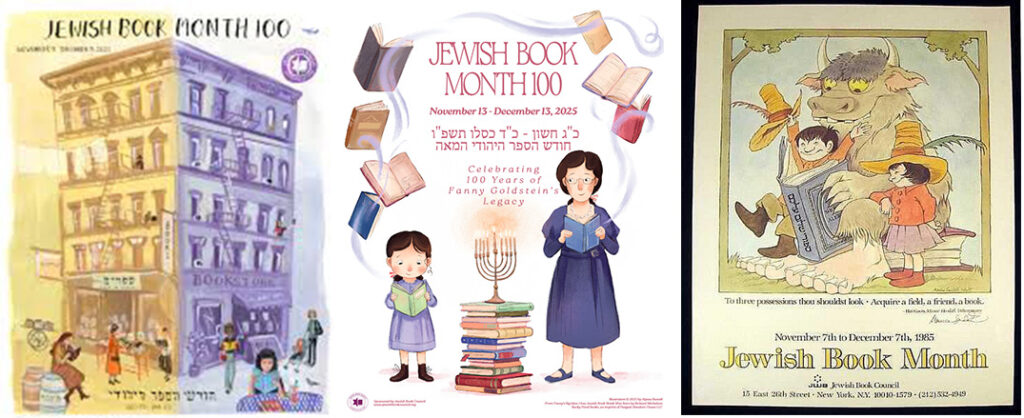
The month leading up to Hanukkah is Jewish Book Month. This year, it began on November 15 and runs until the first night of Chanukah, December 14. Since 2025 marks the 100th anniversary of this celebration of Jewish books, the Jewish Book Council has done much to enhance the celebration.

Take a look at this list of the hallmark fiction books of the last 10 decades. How many have you read?

Jewish Book Week began in Boston when Fanny Goldstein, a Jewish librarian at the Boston Public Library decided to display Jewish books to showcase the Jewish culture of many of its branch library’s patrons. By 1940, the week morphed into a month, and the celebration was moved permanently to Hanukkah by 1943.

Fanny was not one note, however. Because she believed in exposing her patrons to other cultures, Fanny created displays about other groups who visited her library. In addition, as she rose through the library ranks and became better known, she spoke frequently on politics and social issues.

During World War II, Goldstein’s committee evolved into the Jewish Book Council, which sponsors this major celebration of Jewish books and authors. Visit the JBC site for more about Jewish Book Month, including a display of the beautiful posters created by some of the most well-known Jewish artists and illustrators, reviews of new books, interviews with authors, and essays about authors and books.

For more information on this remarkable, far-sighted, and open-minded woman, read Richard Michelson’s biography, Fanny’s Big Idea: How Jewish Book Week Was Born, or follow this link.

And come into our library to browse the shelves, which hold many treasures of Jewish literature.

Thanksgiving: Letting in the Light

This morning as I handed Eloise a plate of pancakes—because sometimes I actually do have my act together early and pancakes on school days can happen, and actually they were oladushki, which as all y’all from the FSU will know are cooked in oil not butter, which makes them perfect for this month of Chanukah, but none of this is the point—the point is that as I set her breakfast down at 6:45 am, she looked at me and said, “Mommy, did you see the sunrise?”

I had not, because while nice weekday breakfasts do sometimes happen, they involve stumbling around in the dark pretending the day has not truly begun, so no, I hadn’t opened the shades or looked outside yet. Turns out it was a gorgeous pink-sky morning, and I’d missed it.

‘Tis the season, dark at breakfast and at dinner again, too. We feel the creeping darkness in our moods as we inch toward the solstice. But more than that—symbolically—isn’t this right on, the way we constitutionally avoid brightness of many kinds, at all seasons, missing what is beautiful and shimmering just beyond the edges of our awareness as we choose the dark and depressing instead? This is what the Sefat Emet and other rabbis noted about this month of Kislev we are now in, at the end of which—around the solstice—we begin lighting the Chanukkah candles. The darkness this month forces us to look for what is concealed rather than what is obvious, to light extra lights. Time to lift up those blinds and see the hidden glory behind.

Which brings me to Thanksgiving. Our National Mood Disorder has us all exhibiting a variety of symptoms. The list is long and I won’t get into it here. All I’ll say is that it can feel hard to see that there is light here with us, too.

According to the Smithsonian, “festivals of Thanksgiving were observed sporadically on a local level for more than 150 years.” The first Thanksgiving celebrations were summer affairs, giving thanks for rain after a drought and related light-out-of-darkness agricultural moments. In 1789, Elias Boudinot, representing New Jersey in the House of Representatives, moved that a national day of Thanksgiving be held to thank God for giving the American people the opportunity to create a Constitution to preserve their hard-won freedoms. After a Joint Committee approved the motion, President George Washington proclaimed that the people of the United States would observe “a day of public thanksgiving and prayer” on Thursday, November 26. It didn’t catch on, however, for another 150 years, with some (like Thomas Jefferson) objecting on the grounds that it violated separation of church and state. But get this:

“Most of the credit for the establishment of an annual Thanksgiving holiday may be given to Sarah Josepha Hale. Editor of Ladies Magazine and Godey’s Lady’s Book, she began to agitate for such a day in 1827 by printing articles in the magazines. She also published stories and recipes, and wrote scores of letters to governors, senators, and presidents. After 36 years of crusading, she won her battle. On October 3, 1863, buoyed by the Union victory at Gettysburg, President Lincoln proclaimed that November 26, would be a national Thanksgiving Day, to be observed every year on the fourth Thursday of November.”

Note that wonderful 36, double chai, tucked in there. Sometimes beautiful traditions are hidden and take a long time to see the light. And maybe that’s part of the wisdom of this week’s parasha, too, because the Joseph story we begin reading now is as much about what is concealed as what is revealed. Joseph enters the world in this week’s parashah, and from the start nothing about him is straightforward. His dreams will be misunderstood, his identity buried again and again, his gifts and God’s hand invisible until they are brought to light.

Thanksgiving gives us a national moment that mirrors this spiritual lesson. Giving thanks is the practice of noticing what we otherwise overlook, taking stock not only of the things that shine brightly but of the extraordinary that live concealed by the everyday. In a season of darkness—literal and metaphorical—Thanksgiving offers us a chance to pause and try to name the small goodnesses that would otherwise go unnoticed. In that way, it aligns with Kislev’s invitation: Lift the blinds. Light the candles. Let the hidden colors and light in.

And because gratitude is a practice, not just a feeling, I want to offer two simple takeaways for this week.

First: bless your food at the Thanksgiving table. In Jewish life, we go granular, giving thanks not just for the category “food” but for exactly what we are blessed to have on our plates. If the main centerpiece is the turkey, then recite this one—which is one of my favorite blessings in the entire canon:

בָּרוּךְ אַתָּה ה׳ אֱלֹהֵינוּ מֶלֶךְ הָעוֹלָם שֶׁהַכֹּל נִהְיָה בִּדְבָרוֹ.

Barukh attah Adonai eloheinu melekh ha-olam, she-ha-kol nihyeh bi-d’varo.

Praised are You, Lord our God, Sovereign of the Universe, at whose word all things come into being. For a full directory of food blessings (it’s not always hamotzi, that’s the point!) click here.

Second: join our Gratitude Circle, back by popular demand (or maybe just rabbinic whim) for year two. A WhatsApp group we’re opening this week for you and anyone in your life who wants to join in. Every day from Thanksgiving through the end of Chanukah (December 22) we will each post one thing we are grateful for. No cross-talk, no politics, no commenting besides an emoji, just a running list of things we are grateful for. Think of it like adding one more candle each night. Each person offering one small spark from their day, the light building as we share it with one another.

During this month of searching for light in the dark, I hope this is how we will find it: together noticing, naming, sharing goodness and gratitude, to reveal what is already here but too often hidden from view. Happy Thanksgiving, may our giving thanks be part of the way from darkness to light.

Gratitude


At this time in our secular year, we are supposed to be thankful. Of course, we should be thankful all year round. Our Jewish tradition has almost endless ways to say thank you.

The book that I’d like to bring to your attention is not a specifically Jewish book, but its premise of thankfulness is very Jewish.

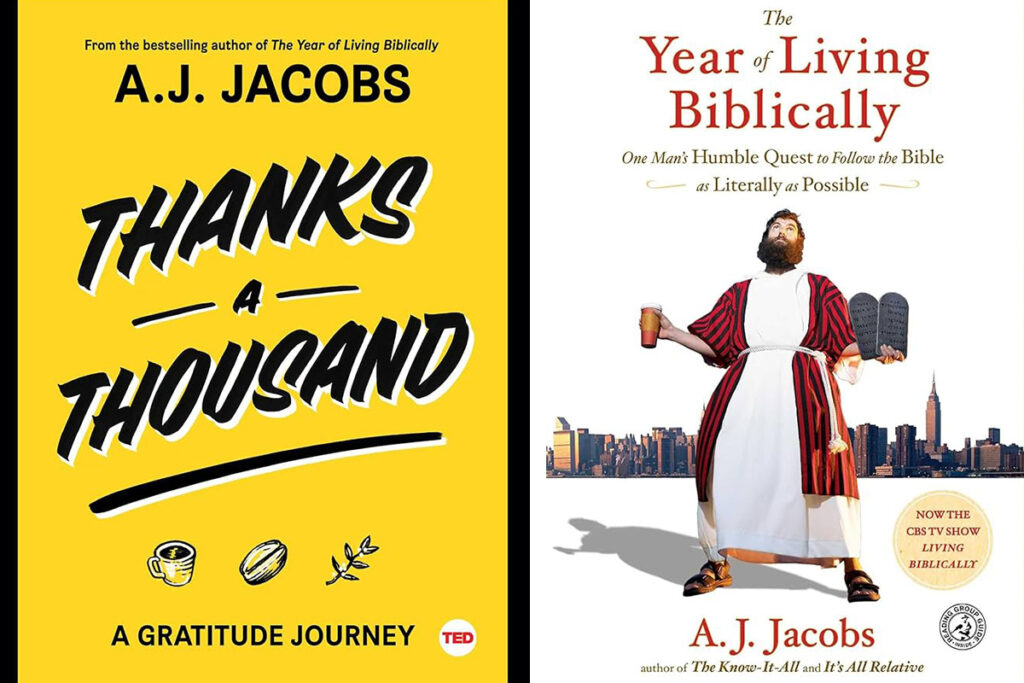
A.J. Jacobs has made a literary career of immersing himself in a topic: he’s spent a year living Biblically, which he describes in The Year of Living Biblically: One Man’s Humble Quest to Follow the Bible as Literally as Possible. He has attempted to live as the Founding Fathers did, which he writes about in The Year of Living Constitutionally: One Man’s Humble Quest to Follow the Constitution’s Original Meaning.  He’s tried to become a know-it-all by reading his way through an entire encyclopedia in The Know-It-All: One Man’s Humble Quest to Become the Smartest Person in the World.

In 2018, inspired by a conversation with his then 10-year-old son, he decided to be thankful, and in Thanks a Thousand: A Gratitude Journey sets out to thank everyone associated with the cup of coffee purchased at Joe Coffee, his local coffee shop.

From the owner of the shop to the manufacturer of the cup to the farmers and distributors, Jacobs discovers how intricate the world of the simplest thing is. It is almost overwhelming but also illuminating as the reader realizes how interconnected our world and its bounty are. Jacobs says,” If we connected the world with threads signifying gratitude, the result would be as thick as a blanket.”

How grateful people are to be noticed and thanked.

You may not want to rush to the nearest coffee bar to say thank you, but as we approach Thanksgiving, you might be inspired to be more appreciative of whoever puts food on the table in your home.

As Rabbi Nachman of Breslov taught, giving thanks for even the smallest thing is important. For him, gratitude was a path to joy and connection with God.

Mamdani, Mikie, and Making Minyan

Somewhere between Mamdani and Mikie, between the government shutdown and canceled flights, a week of normal life went by. I ate more than my share of leftover Halloween candy, got Eloise off to school, served my weekly stint on a grand jury, and called the tree guy about the storm-damaged oak in my backyard. God did not appear to me as in the Torah’s opening verse this week, when Abraham sat “in the heat of the day” outside his tent. But I talked to God a lot — not only because 5786 is about renewing my prayer life, but because there is a lot to discuss.

“Will you sweep away the righteous with the wicked?” Abraham asks. That’s our question, too, these days. Aren’t there so many good, righteous people worth caring for? Whether it’s immigration raids or SNAP benefits, we share with Abraham that yearning — that the existence of righteous people might itself be reason enough to save the place. Rabbi Avital Hochstein, drawing on Onkelos and Rashi, teaches “in light of the presence of the righteous, [there is by Abraham] a call for God to tolerate, to bear, to accept or even absorb evil — to refuse to let the wickedness of others dictate God’s response.” 

In other words, Abraham asks that we be judged by the merit of those who choose good and justice, not condemned for the worst among us. That feels vital now, not because I fear God’s wrath but because I worry about ours.

None of us — not our leaders, not even our enemies — are wholly righteous or wholly wicked. The Mishna says our lives are a balance of both, and our task is to keep tipping the scales toward good. That’s teshuvah: trying again and again, convinced that inside each of us is a spark of light longing to shine. Rebbe Nachman of Breslov warned against despair; he taught that our sense of darkness only blocks the light from breaking through. We must find the light within ourselves — even one small point — and let that holy spark light up the world around us. And we must find the light in one another, too.

Neither Mamdani nor Trump is pure evil or pure good. Whether you voted Republican or Democrat — and I love that we are a congregation of both parties — whether you love everything or nothing about what the administration is doing, Abraham’s argument is not only with God, but with us. Generalizing based on despair and seeing only the worst of a society is not right. It is not good to dismiss people, cities, or entire nations out of outrage. 

Abraham, God’s chosen one, negotiates. If ten righteous people can be found, don’t destroy the city. God agrees. That’s how we get 10 for a prayer quorum in Jewish life: if we have 10 willing to pray — to hope, have faith, see the good – it’s worth saving the city. And because people aren’t wholly good or wholly bad — if we can find even a tiny percent of goodness in everyone, including those who cause us despair, we emulate God. We tip the world toward justice through patience, compassion, and the courage to keep seeing light in dark and complicated places.

Maybe that’s the real work of this moment: to refuse despair. To speak with God not only when we see angels at the tent door, but when the oak is split, the flights are canceled, outrage runs high, and mercy feels impossible. To keep looking for that tenth — in others, in ourselves — and believe we still have the power to save the world.

The Golden Pages Book Club


Hello, Readers!

I am looking forward to the first Golden Pages Book Club on Thursday, November 6. There is one copy of Threadbare left in the library. The other two books in the “Gilded City” series are also available. All the books have recurring characters.

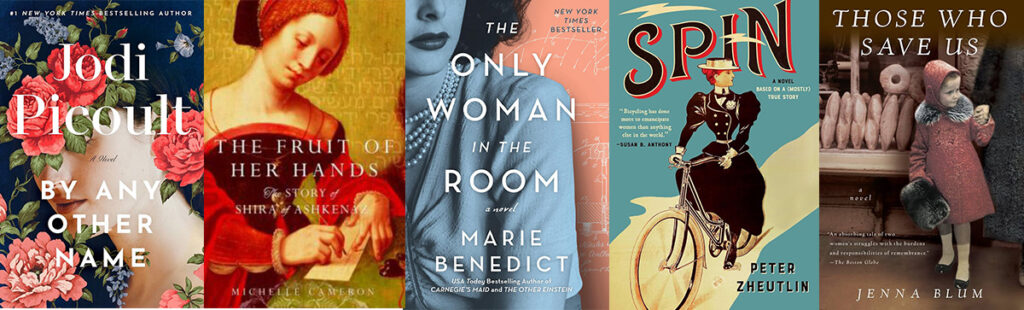
The following list is a group of books that you may enjoy if you like historical fiction, the same genre as Threadbare. Keep in mind that all these books are based on at least a kernel of history, and many are much closer to historical reality than we might believe.

This list only scratches the surface of historical fiction in the adult section of the library. In addition, there are crossover books in both the Young Adult and Juvenile sections.

Benedict, Marie. The Only Woman in the Room. Did you know that Hedy Lamarr was not only a beautiful movie star but also a scientist? This is her story filtered through the genre of historical fiction.

Blum, Jenna. Those Who Save Us. Set after World War II, this novel focuses on the main character’s inherited shame and guilt over her German heritage.

Cameron, Michelle. The Fruit of Her Hands. The story of Shira of Ashkenaz, the wife of famed Rabbi Mair of Rothenberg, is based on mere snippets of history, as are the lives of most medieval women. However, Jewish history comes alive as experienced by this extraordinary 13th-century woman.

Carner, Talia. The Third Daughter. Fourteen-year-old Batya and her family escape Russia’s pogroms, but instead of finding freedom in the United States, she is tricked into the promise of marriage and ends up being sold as a prostitute in Buenos Aires. Unfortunately, this sex trafficking really happened.

Edwards, Shaunna. The Thread Collectors. Talented Black seamstress Stella and New York Jewess Lily find themselves drawn together by the fates of their husbands, soldiers in the Civil War, and their stitchery. There is, indeed, power in women’s work.

Hertmans, Stefan. The Convert. In 11th-century France, Christian Vigdis Adelais, daughter of a celebrated knight, falls in love with David Todros, a yeshiva scholar. Can anything good come from this romance? Great local color as the characters travel through Europe seeking a safe haven.

Kadish, Rachael. The Weight of Ink. This is a novel of history, women, and Jewish identity. Using a split-screen format, the author tells the story of London Jewish life in the 1660s and scholarship in the early 21st century. The story unites two remarkable women through some rediscovered 17th-century documents.

Picoult, Jodi. By Any Other Name. This is another split-screen plot, taking place in Shakespeare’s time and contemporary New York. Under consideration is who really wrote Shakespeare’s plays and sonnets, as well as the value of women’s creative work. The title tells it all.

Zheutlin, Peter. Spin: a novel based on a mostly true story. In 1895, Bostonian (but Jewish immigrant) Annie Londonderry began an around-the-world bicycle trip. This jaunt was declared “ the most extraordinary journey ever undertaken by a woman.”  Whoever dreamed that Annie Cohen Kapchovsky could and would do such a thing? Zheutlin is a descendant of Annie.

Kol Nidre Address (Oct 1, 2025)

Opening
This morning, the first thing I did was grab my phone and scroll – and unfortunately, it was a doom scroll, not a hope scroll as Rabbi suggested on Rosh Hashanah that we should all aspire to. I was bombarded with news about Israel’s war, antisemitism raging around the world, and the seemingly endless cycle of political division and discord. It came to me through social media, news alerts, and WhatsApp messages. I started my morning with a pit in my stomach, a heaviness hard to describe in words, and thus all the more isolating. Sadly, this feeling was not a new one. For the past two years, it has become my normal.

We all have different strategies to cope. We walk, meditate, bike, practice yoga. I love pilates and crossword puzzles. We pray — sometimes in the sanctuary or chapel, oftentimes quietly in our hearts as we go about our day. We do these things, and they help. But if we’re truly honest with ourselves, they don’t make the pit go away.

So what does? As the late relationship expert Dr. Sue Johnson often reminded us, humans are social mammals. Study after study confirms what our hearts already know… we are wired for connection. Connection to our spouses, family, and friends, to our community. Connection is the essential antidote to that pit.

A year ago, I stood here and told you that living a Jewish life was an important act of resistance to insidious antisemitism. That remains true, perhaps more than ever. But today, a year later, I want to focus on something equally powerful that living a Jewish life can provide: joy. The joy that flows from connection. The joy that comes from being part of a Jewish community — from our oneness as a people.

I often see this joy in the lives of my cousins in Israel. I chat with them and follow their lives on social media – at least the fun parts — my cousin Lihi’s wedding at the dairy moshav of her husband Shlomi’s family, vacations, trips with their kids to the beach, fancy cocktails with friends, leisurely time with family.

What I see is that Israelis are living their lives, in the midst of a war, finding joy where and when they can, with their extended community — living their lives as Jews who refuse to succumb to those who seek to destroy them. And I want that for all of us.

Judaism had figured out the importance of connection long before Dr. Sue Johnson’s research. It is a communal religion by design. We mourn together, we celebrate together, and even our prayers reflect this concept.

Vidui and Unity
Take the Vidui as an example. It is the confessional prayer we recite on these holy days, and it has us speak in the plural. It does not say I have sinned — it has us say ashamnu, bagadnu, gazalnuwe have sinned, we have betrayed, we have stolen. Our tradition teaches that we are all responsible for one another, that the failings of one touch us all.

We are not alone. And that is where the deepest joy of Jewish life comes from — knowing we are not alone, but bound together, finding strength and resilience in one another.

Differences Not Divisiveness
Yet, experiencing that joy — that beautiful sense of being bound together — isn’t always easy in practice. Despite our oneness as a people, the simple fact is that we don’t all think alike. You know the saying: put 100 Jews in a room, and you’ll get 100 opinions…and that often feels like an understatement! And sometimes — let’s be honest — our differences lead to conflict. We disagree over Israel, over politics, over how to practice our Judaism. We debate and argue, and that’s actually very Jewish of us. But we cannot let disagreement devolve into divisiveness.

We need perspective.

Over the past year, I read many statements from released hostages and hostage family members. Each and every one called for unity. I was particularly moved by the words of Eli Sharabi, shortly after being freed from Gaza — a shadow of his former self, yet still strong enough to say this:

“Sometimes, within the noise, in the division, in the shouting, we are forgetting the most basic thing: We are in this together. One blood. One heart. One. And when our enemy sees us as one, maybe it is time for us to see the same thing in ourselves. Because only together will we win. Straight up.”

If he could see this with such clarity in his darkest hour, surely we, in our freedom, can embrace it too.

Rabbi Treu often speaks of her desire for a “big tent” — a place where each person can bring their whole self, knowing there is space for individuality, while also acknowledging our deep connection to one another. We cannot let our differences get in the way of that joyful connection. Because without it, without each other, we lose the antidote to that isolating heaviness that I spoke of earlier.

My sincerest hope is that in this New Year, we will chart our path toward unity — not by thinking alike, but by listening deeply, and by remembering that we are, fundamentally, one people. Because it is only in that unity, in that connection, that we can truly access the joy of Jewish living.

Celebrating Judaism, L’dor V’dor
Together, we must celebrate our Judaism. We must cherish it. Teach your children, your grandchildren, your non-Jewish friends, what it means to be and to live as Jews.

I saw the power of this, in the pure voice of my 3-year old grandson Cooper. He attends preschool at Park Avenue Synagogue in New York. Last summer, in a beach house rental, I brought along a ziplock bag containing candlesticks, kippot, and a tie-dyed challah cover my daughter Nicole made when she was in preschool – I’m sure some of you have the same one at home. The bag sat on the kitchen table. Cooper pointed and said, “LoLo (that’s what he calls me), there’s Shabbat in there.”

And from the wonder in his voice, I knew that Gary and I might have done something right… that the cycle continues. But it only continues if we keep living it, teaching it, and celebrating it together.

How to Use Oheb
So my friends, that is why Oheb Shalom matters. This synagogue isn’t just a place to attend once or twice a year out of a feeling of obligation. It is a place to root your children and grandchildren in Jewish joy. To learn and grow as adults through study and discussion. To celebrate, to mourn, to mark joyous milestones with your Jewish community. To belong and feel connected as one Jewish people. 

And it is because Oheb Shalom does matter, that it is essential we prioritize it, and that we support it. This year, instead of a Free Will Address on Rosh Hashanah, we shared an FAQ about synagogue finances. It dawned on us that many people don’t understand how the finances of Oheb work.  I hope you saw it in your prayer book on Rosh Hashanah and in our newly printed Directory, and I hope you read it. It explains why our Annual Funding Appeal — a new name for our former Free Will Campaign — is critical to sustaining our sacred home.

We need your time, and your financial support, to ensure that Oheb Shalom continues to thrive for us and for generations to come.

Closing
So yes — it is difficult to be a Jew today. But it is also a blessing. Because when we carry one another through the heaviness, when we choose joy in Jewish living, we all come out stronger. My grandson Cooper saw the joy of celebrating Judaism in a ziplock bag; where do you see it?

My blessing for us this year is that you see it here at Oheb Shalom, so that we can pass this beautiful community from one generation to the next.

G’mar chatima tovahMay we all be inscribed in the book of life, and may it be a good and sweet and healthy year, for us, our families and our people all around the world.

Genesis


Some first families live in white houses. Others live in palaces. Our Jewish first family lived in
Paradise, in the Garden of Eden.

Of course, the first family was unable to follow the rules and got itself evicted from Paradise.
That event also — in simplistic terms — defines one of the main differences between Judaism and
Christianity. The Fall, as it’s called in Christianity, is the reason for humanity’s suffering.

In Judaism, again in simplistic terms, the lack of discipline on Eve’s part allowed humans to
grow and use the gifts that God gave them.

As we begin to read our Jewish story again, readers might be interested in investigating how
thinkers interpret the stories in Genesis for both child and adult readers.

The following are some of the books on Genesis in our library:

Reading Genesis. A collection of essays by experts in fields such as psychology, literature,
and law sheds new light on the text of Genesis.
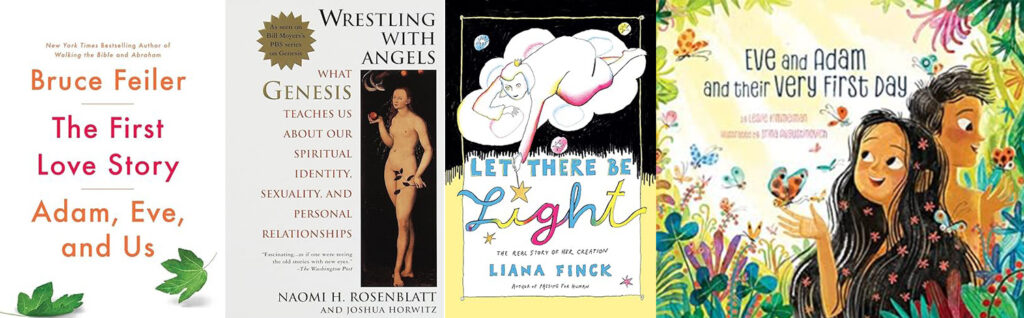
Feiler, Bruce. The First Love Story: Adam, Eve, and Us. The author explains how Adam and Eve
serve as models for relationships, family, and togetherness.
Finck, Liana. Let There be Light: the real story of her creation. This graphic novel version
reinvents the story of creation with God as a woman.
Kimmelman, Lesley. Eve and Adam and the Very First Day. (Juvenile)
Levine, Amy-Jill. The Bible With and Without Jesus: How Jews and Christians Read the Same
Stories Differently
.
Moyers, Bill. Genesis. Explores the contemporary relevance of the stories in the Bible’s first
book.
Rosenblatt, Naomi. Wrestling with Angels: What the First Family of Genesis Teaches Us About
Our Spiritual Identity, Sexuality, and Personal Relationships
.
Sasso, Sandy. Adam and Eve’s First Sunset. (Juvenile)
Zevit, Ziony. What Really Happened in the Garden of Eden. Drawing on a variety of academic
disciplines, the author discusses what the story of Adam and Eve probably meant to the ancient
Israelites.